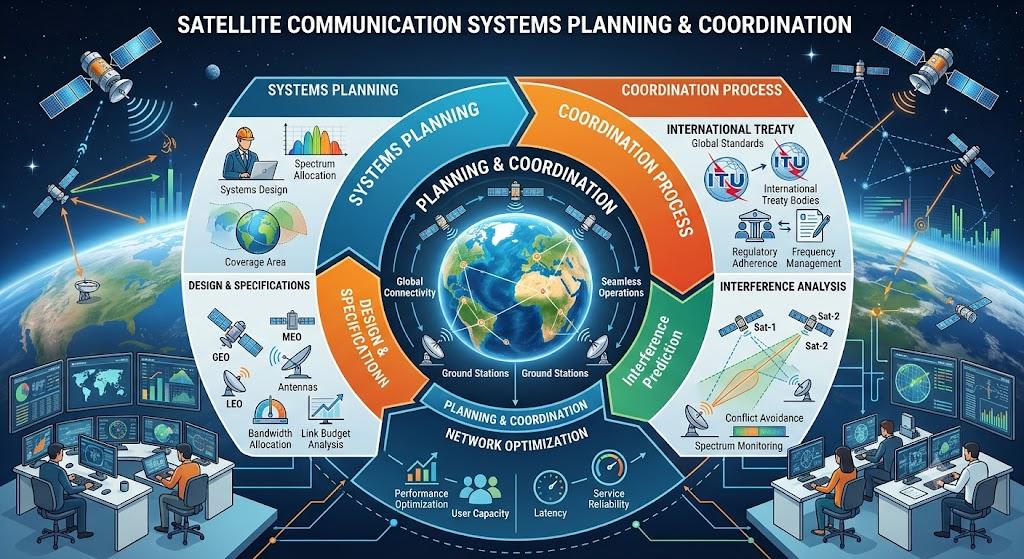
Satellite Communication Systems Planning & Coordination
Get all you need to know and more about Satellite Communication Systems Planning and Coordination
Course content
Introduction
The global space segment is undergoing an unprecedented architectural transformation. As modern satellite communication systems evolve, a structural revolution is redefining corporate networks, defense infrastructures, and global telecom backhauls. Moving far beyond legacy transponder configurations, today's network deployment demands mastery over advanced satellite technology, dynamic network topologies, precise satellite coordinate systems, and next-generation VSAT deployments.
This intensive course bridges fundamental electromagnetic principles with elite operational execution. It is engineered specifically for engineers, network planners, and telecommunications leaders who refuse to rely on automated templates or generic overviews. Whether you are building high-resilience corporate infrastructure or aiming to master complex satellite communication systems design, this masterclass equips you with the raw technical tools and regulatory frameworks needed to deploy flawless, high-performance orbital networks.
Course Objectives
By the end of this Satellite Communication Systems training program, participants will be able to:
- Introduction to Satellite Communication Systems: Establish an authoritative, end-to-end understanding of orbital communication elements, spacecraft payloads, and how they seamlessly integrate within global terrestrial networks.
- Explore Satellite Band Frequencies: Master the physical nuances, attenuation trade-offs, and industrial deployments of major operational bands, including L-band, C-band, Ku-band, and Ka-band infrastructure.
- Examine Security Risks in Satellite Systems: Dissect modern security vulnerabilities unique to space-link architectures, implementing robust AAA (Authentication, Authorization, and Accounting) frameworks to insulate uplinks and downlinks from intercept or exploit.
- Learn About Wireless LAN & Other Access Technologies: Govern the convergence points between terrestrial wireless LAN configurations, cellular edge routing, and satellite transponder access interfaces.
- Understand Link Budgeting for Satellite Communication: Perform manual and software-assisted link budget calculations to maximize signal availability, evaluate carrier-to-noise ratios, and prevent costly link outages.
Course Outlines
Day 1: Introduction to Satellite Communication Systems
- Introduction to Satellite Communication: Unpacking the structural foundations of orbital communication architectures and their critical role in global enterprise connectivity.
- Advanced Satellite Communication Systems: Analyzing the ongoing shift toward software-defined payloads, high-throughput satellites (HTS), and multi-layered constellations.
- Multiple Access Techniques: Engineering maximum spectral efficiency by mastering FDMA, TDMA, CDMA, and demand-assigned random access protocols.
- Digital Modulation Techniques: Dissecting the implementation of robust modulation methodologies including ASK, FSK, BPSK, and QPSK within noisy RF environments.
- Data Rate vs. Baud Rate: Clarifying the distinct boundaries between raw bit rates and symbol rates to properly optimize spectral bandwidth.
Day 2: Earth Station Antennas
- Earth Station Antennas: Engineering earth station interfaces, focusing on RF feed assemblies, low-noise blocks (LNBs), and power amplifiers.
- Types of Antennas: Evaluating structural deployments for highly specialized hardware, including Satellite News Gathering (SNG) vehicle rigs, tactical flyaway kits, and stabilized maritime tracking platforms.
- Pointing and Tracking Mechanisms: Implementing advanced step-track, monopulse, and program-track methodologies to maintain seamless satellite acquisitions under dynamic environmental loads.
Day 3: Satellite Band Frequencies & Regulatory Limitations
- Understanding Satellite Frequencies: Navigating the real-world operational trade-offs, rain fade profiles, and hardware complexities from L-band up to high-capacity Ka-band links.
- Small Antennas at Ku-Band: Maximizing the efficiency of small-aperture terminals for enterprise vsat routing networks without inducing adjacent-satellite interference.
- Electromagnetic & Radio Spectrum Allocation: Mapping out international radio spectrum management to ensure clean, non-interfering orbital operations.
- EIRP Density Limitations: Navigating strict regulatory boundaries and boundary calculations imposed on Effective Isotropic Radiated Power (EIRP) by the FCC, Intelsat, and the ITU.
Day 4: Satellite Communications System Design
- Satellite System Design Engineering: Architectural engineering of space payloads, solar arrays, transponder sub-systems, and ground segment controls.
- Link Budgets Masterclass: Developing structural link budgets from scratch, accounting for atmospheric absorption, polarization losses, and free-space path loss.
- Propagation Interference and Regulation: Identifying cross-polarization anomalies, solar outages, and terrestrial microwave overrides while deploying clean links.
- Satellite Network Coordination: Implementing frequency-sharing agreements between Geostationary Satellite Orbit (GSO) Fixed-Satellite Service (FSS) networks across both planned and unplanned allocations.
Day 5: Orbit Types & Spectrum Allocations for Satellite Systems
- Orbit Types (GEO, LEO, MEO, HEO): Mapping out orbital telemetry profiles and analyzing how varying geometries dictate path loss, Doppler shifts, and system footprints.
- Link Budgets for Multiple Links: Scaling calculations to handle complex multi-hop relays, multi-destination broadcasts, and inter-satellite cross-links.
- Effects of Propagation Delay: Engineering protocols to mitigate the severe latency effects of deep-space links on real-time corporate applications and TCP/IP handshakes.
- Spectrum Allocations Execution: Establishing rigid technical compliance workflows with international frequency tables to guarantee interference-free global deployments.
Why Attend This Course: Wins & Losses!
What You Gain (The Wins) | What You Risk (The Losses) |
|---|---|
Comprehensive Satellite Communication Training
Build an exhaustive, end-to-end capability covering both foundational physical mechanics and high-level aerospace network deployments.
| Outdated Methodology Reliance
Remaining constrained to generic, superficial IT workflows while failing to grasp the math behind complex space-segment architectures.
|
Deep Technical Authority
Master link budget execution, precise satellite coordinate systems, and frequency coordination matrices needed to make definitive engineering calls.
| Costly Operational Failures
Suffering from unexpected signal dropouts, unmitigated rain fade, or catastrophic coordination disputes with neighboring networks.
|
Valued Industry Credentials
Secure a professional satellite communication certification that validates your specialized technical capacity to global employers.
| Career Stagnation
Getting passed over for senior aerospace design, defense architecture contracts, or tier-one telecom engineering leadership roles.
|
Future-Proof Hands-On Expertise
Incorporate advanced concepts like Activity-Based Intelligence (ABI) and navigate rapid payload evolutions with complete strategic confidence.
| Competitive Obsolescence
Falling behind nimbler, software-defined competitors who leverage next-generation orbital nodes to dominate the connectivity market.
|
Conclusion
Mastering satellite communication systems planning and coordination is the definitive key to unlocking true operational resilience, secure communications, and cross-border telecommunications infrastructure. As global communications migrate rapidly toward hyper-dense, software-defined space architectures, organizations cannot afford a passive or unverified approach to network design.
The Satellite Communication Systems Planning & Coordination course replaces high-level generalities with rigorous, battle-tested engineering methodologies. Whether your goal is to manage global corporate VSAT nodes, navigate international ITU coordination frameworks, or optimize high-stakes defense link profiles, this masterclass equips you to execute flawlessly.
Upcoming sessions
| City | Country | Date & time | Price | |
|---|---|---|---|---|
| Istanbul | Turkey | To be announced | 4,900.00 | Register now |
| Amman | Jordan | To be announced | 4,900.00 | Register now |
| Dubai | UAE | To be announced | 4,900.00 | Register now |
| Kuala Lumpur | Malaysia | To be announced | 4,900.00 | Register now |
| Cairo | Egypt | To be announced | 4,900.00 | Register now |
| Casablanca | Morocco | To be announced | 4,900.00 | Register now |
| Cape Town | South Africa | To be announced | 4,900.00 | Register now |
| Amsterdam | Netherlands | To be announced | 5,900.00 | Register now |
| Barcelona | Spain | To be announced | 5,900.00 | Register now |
| Paris | France | To be announced | 5,900.00 | Register now |
| Madrid | Spain | To be announced | 5,900.00 | Register now |
| Rome | Italy | To be announced | 5,900.00 | Register now |
| London | UK | To be announced | 6,100.00 | Register now |